Biotechnology: Principles and Processes ke NEET previous year questions, saal ke hisaab se. Option dabao, turant check karo, aur step-by-step solution dekho. Har answer NTA ki official answer key se match kiya hua.
6 questions1 paper
Q1NEET 2025Q.92Easy
Polymerase chain reaction (PCR) amplifies DNA following the equation.पॉलीमरेज़ श्रृंखला अभिक्रिया (PCR) किस समीकरण के अनुसार DNA का प्रवर्धन करती है?
Sahi answer: (2)
Each PCR cycle doubles the DNA. So one DNA molecule gives $2^n$ copies after $n$ cycles.PCR का हर चक्र DNA को दोगुना करता है। इसलिए $n$ चक्रों के बाद एक DNA अणु से $2^n$ प्रतियाँ बनती हैं।
Q2NEET 2025Q.115Medium
In the above represented plasmid, an alien piece of DNA is inserted at EcoRI site. Which of the following strategies will be chosen to select the recombinant colonies?ऊपर दर्शाए गए प्लाज़्मिड में EcoRI स्थल पर एक विजातीय DNA खंड डाला जाता है। पुनर्योगज (recombinant) कॉलोनियों को चुनने के लिए निम्न में से कौन-सी विधि अपनाई जाएगी?
Sahi answer: (3)
The EcoRI site lies inside the β-galactosidase (lacZ) gene. Inserting DNA there inactivates the gene (insertional inactivation). On a chromogenic substrate, non-recombinant colonies make the enzyme and turn blue, while recombinant colonies cannot and stay white. So white colonies are selected.EcoRI स्थल β-गैलेक्टोसाइडेज़ (lacZ) जीन के अंदर है। वहाँ DNA डालने से जीन निष्क्रिय हो जाता है (निवेशी निष्क्रियता)। क्रोमोजेनिक सब्सट्रेट पर अपुनर्योगज कॉलोनियाँ एंज़ाइम बनाकर नीली हो जाती हैं, जबकि पुनर्योगज कॉलोनियाँ नहीं बना पातीं और सफ़ेद रहती हैं। इसलिए सफ़ेद कॉलोनियाँ चुनी जाती हैं।
Q3NEET 2025Q.126Easy
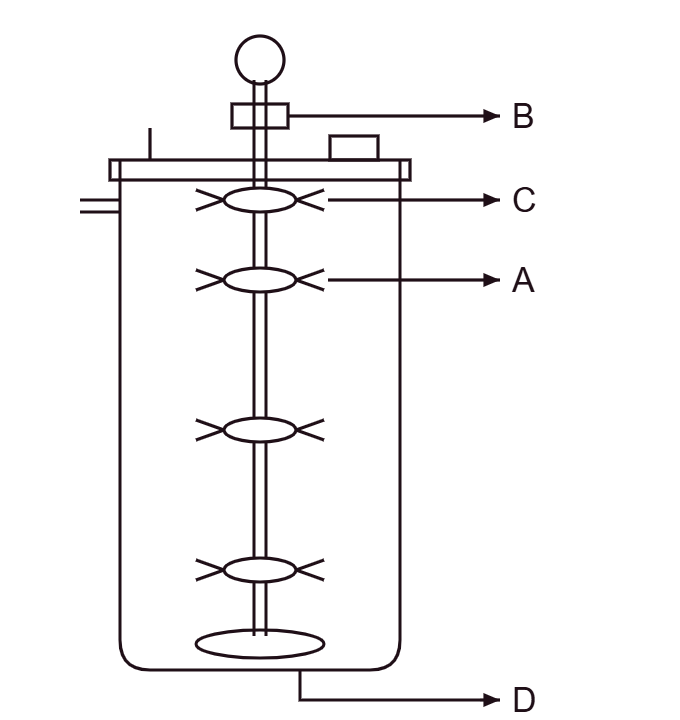
Identify the part of a bio-reactor which is used as a foam breaker from the given figure.दिए गए चित्र में बायो-रिएक्टर का वह भाग पहचानें जो फ़ोम ब्रेकर (झाग तोड़ने वाला) के रूप में उपयोग होता है।
Sahi answer: (4)
In a stirred-tank bioreactor, the foam breaker is the topmost impeller-like part on the shaft, just below the lid, which breaks the foam formed at the surface of the broth. It is labelled C. B is the motor coupling, A is a flat-bladed impeller and D is the outlet.हिलाने वाले टैंक बायो-रिएक्टर में फ़ोम ब्रेकर शाफ़्ट पर ढक्कन के ठीक नीचे सबसे ऊपर लगा भाग है, जो माध्यम की सतह पर बने झाग को तोड़ता है। इसे C से दर्शाया गया है। B मोटर से जोड़, A एक इम्पेलर और D निकास है।
Q4NEET 2025Q.136Medium
Given below are two statements: Statement I: The DNA fragments extracted from gel electrophoresis can be used in construction of recombinant DNA. Statement II: Smaller size DNA fragments are observed near anode while larger fragments are found near the wells in an agarose gel. In the light of the above statements, choose the most appropriate answer from the options given below:नीचे दो कथन दिए गए हैं: कथन I: जेल वैद्युतकणसंचलन से निकाले गए DNA खंडों का उपयोग पुनर्योगज DNA बनाने में किया जा सकता है। कथन II: एगरोज़ जेल में छोटे आकार के DNA खंड ऐनोड के पास और बड़े खंड कुओं (wells) के पास दिखते हैं। उपरोक्त कथनों के आलोक में, नीचे दिए गए विकल्पों में से सबसे उपयुक्त उत्तर चुनें:
Sahi answer: (1)
Statement I is correct: the separated bands are cut out of the gel (elution) and the purified DNA is used to construct recombinant DNA. Statement II is correct: DNA is negatively charged and moves towards the anode. Smaller fragments move farther, so they lie near the anode, while larger fragments stay near the wells.कथन I सही है: अलग हुए बैंड जेल से काटकर निकाले जाते हैं (इल्यूशन) और शुद्ध DNA पुनर्योगज DNA बनाने में उपयोग होता है। कथन II सही है: DNA ऋणावेशित होता है और ऐनोड की ओर चलता है। छोटे खंड अधिक दूर जाते हैं, इसलिए ऐनोड के पास रहते हैं, जबकि बड़े खंड कुओं के पास रहते हैं।
Q5NEET 2025Q.172Easy
Which of the following enzyme(s) are NOT essential for gene cloning? A. Restriction enzymes B. DNA ligase C. DNA mutase D. DNA recombinase E. DNA polymerase Choose the correct answer from the options given below:जीन क्लोनिंग के लिए निम्न में से कौन-से एंज़ाइम आवश्यक नहीं हैं? A. प्रतिबंधन एंज़ाइम B. DNA लाइगेज़ C. DNA म्यूटेज़ D. DNA रिकॉम्बिनेज़ E. DNA पॉलीमरेज़ नीचे दिए गए विकल्पों में से सही उत्तर चुनें:
Sahi answer: (1)
Gene cloning needs restriction enzymes to cut DNA, DNA ligase to join the fragments into the vector, and DNA polymerase to amplify the gene (PCR). 'DNA mutase' and 'DNA recombinase' are not among the essential tools.जीन क्लोनिंग में DNA काटने के लिए प्रतिबंधन एंज़ाइम, खंडों को वाहक से जोड़ने के लिए DNA लाइगेज़, और जीन के प्रवर्धन (PCR) के लिए DNA पॉलीमरेज़ चाहिए। 'DNA म्यूटेज़' और 'DNA रिकॉम्बिनेज़' आवश्यक उपकरणों में नहीं हैं।
Q6NEET 2025Q.179Easy
The blue and white selectable markers have been developed which differentiate recombinant colonies from non-recombinant colonies on the basis of their ability to produce colour in the presence of a chromogenic substrate. Given below are two statements about this method: Statement I: The blue coloured colonies have DNA insert in the plasmid and they are identified as recombinant colonies. Statement II: The colonies without blue colour have DNA insert in the plasmid and are identified as recombinant colonies. In the light of the above statements, choose the most appropriate answer from the options given below:नीले और सफ़ेद चयनयोग्य चिह्नक विकसित किए गए हैं, जो क्रोमोजेनिक सब्सट्रेट की उपस्थिति में रंग उत्पन्न करने की क्षमता के आधार पर पुनर्योगज कॉलोनियों को अपुनर्योगज कॉलोनियों से अलग करते हैं। इस विधि के बारे में दो कथन नीचे दिए गए हैं: कथन I: नीले रंग की कॉलोनियों के प्लाज़्मिड में DNA निवेशित होता है और इन्हें पुनर्योगज कॉलोनियों के रूप में पहचाना जाता है। कथन II: बिना नीले रंग की कॉलोनियों के प्लाज़्मिड में DNA निवेशित होता है और इन्हें पुनर्योगज कॉलोनियों के रूप में पहचाना जाता है। उपरोक्त कथनों के आलोक में, नीचे दिए गए विकल्पों में से सबसे उपयुक्त उत्तर चुनें:
Sahi answer: (4)
The insert is placed inside the lacZ (β-galactosidase) gene, which inactivates it (insertional inactivation). Recombinant colonies cannot make β-galactosidase and stay colourless (white). Colonies without an insert make the enzyme and turn blue. So Statement I is incorrect and Statement II is correct.निवेशित DNA lacZ (β-गैलेक्टोसाइडेज़) जीन के अंदर डाला जाता है, जिससे वह निष्क्रिय हो जाता है (निवेशी निष्क्रियता)। पुनर्योगज कॉलोनियाँ β-गैलेक्टोसाइडेज़ नहीं बना पातीं और रंगहीन (सफ़ेद) रहती हैं। बिना निवेश वाली कॉलोनियाँ एंज़ाइम बनाकर नीली हो जाती हैं। अतः कथन I गलत और कथन II सही है।
Questions NEET ke official papers se hain. Answers NTA ki official final answer key se match kiye gaye hain. Solutions ExamManzil ne likhe hain. Galti dikhe to batao.