Aldehydes, Ketones and Carboxylic Acids ke NEET previous year questions, saal ke hisaab se. Option dabao, instantly check karo, aur step-by-step solution dekho. Har answer NTA ki official answer key se match kiya hua.
3 questions1 paper
Q1NEET 2025Q.70Easy
The correct order of decreasing acidity of the following aliphatic acids isनिम्न ऐलिफ़ैटिक अम्लों की घटती अम्लता का सही क्रम है
Sahi answer: (3)
Alkyl groups are electron-donating (+I). They destabilise the carboxylate anion and so decrease acidity. HCOOH has no alkyl group, so it is the strongest. Acidity then falls as the number of methyl groups on the α-carbon rises. Order: $\ce{HCOOH > CH3COOH > (CH3)2CHCOOH > (CH3)3CCOOH}$ऐल्किल समूह इलेक्ट्रॉन-दाता (+I) होते हैं। ये कार्बोक्सिलेट ऋणायन को अस्थायी करते हैं और अम्लता घटाते हैं। HCOOH में कोई ऐल्किल समूह नहीं है, इसलिए यह सबसे प्रबल है। फिर α-कार्बन पर मेथिल समूह बढ़ने के साथ अम्लता घटती है। क्रम: $\ce{HCOOH > CH3COOH > (CH3)2CHCOOH > (CH3)3CCOOH}$
Q2NEET 2025Q.78Medium
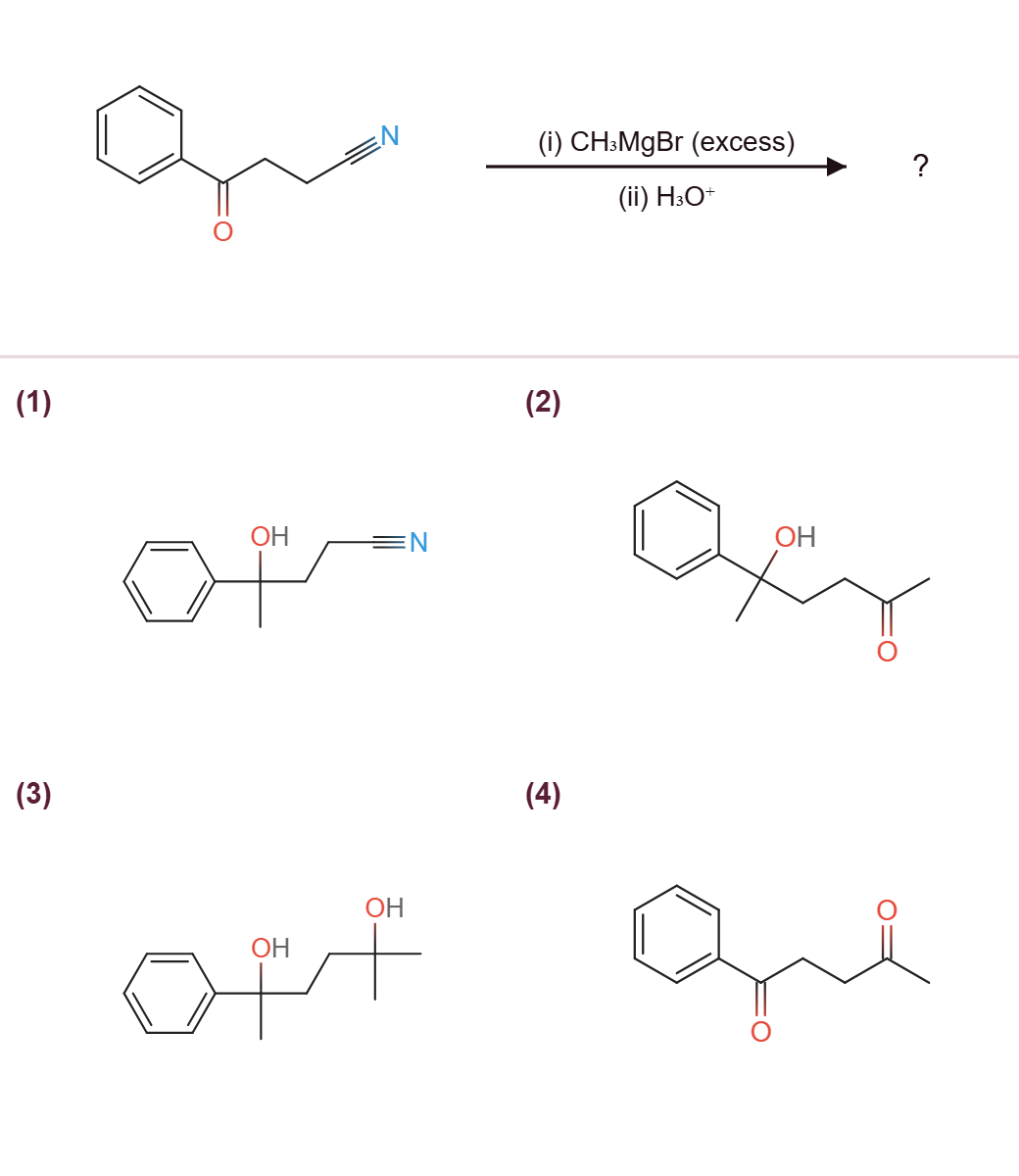
The major product of the following reaction is (see figure; options (1) to (4) are the structures shown): $\ce{C6H5COCH2CH2CN}$ + (i) $\ce{CH3MgBr}$ (excess), (ii) $\ce{H3O+}$निम्न अभिक्रिया का मुख्य उत्पाद है (चित्र देखें; विकल्प (1) से (4) दी गई संरचनाएँ हैं): $\ce{C6H5COCH2CH2CN}$ + (i) $\ce{CH3MgBr}$ (आधिक्य), (ii) $\ce{H3O+}$
Sahi answer: (2)
Excess $\ce{CH3MgBr}$ reacts with both functional groups. The ketone ($\ce{C6H5CO-}$) adds $\ce{CH3-}$ and, after hydrolysis, becomes a tertiary alcohol $\ce{C6H5C(CH3)(OH)-}$. The nitrile ($\ce{-C#N}$) adds $\ce{CH3-}$ to form an imine salt, which hydrolyses to a methyl ketone $\ce{-COCH3}$. Product: $\ce{C6H5C(CH3)(OH)CH2CH2COCH3}$, structure (2).आधिक्य $\ce{CH3MgBr}$ दोनों क्रियात्मक समूहों से अभिक्रिया करता है। कीटोन ($\ce{C6H5CO-}$) पर $\ce{CH3-}$ जुड़ता है और जल-अपघटन के बाद तृतीयक ऐल्कोहॉल $\ce{C6H5C(CH3)(OH)-}$ बनता है। नाइट्राइल ($\ce{-C#N}$) पर $\ce{CH3-}$ जुड़कर इमीन लवण बनता है, जो जल-अपघटित होकर मेथिल कीटोन $\ce{-COCH3}$ देता है। उत्पाद: $\ce{C6H5C(CH3)(OH)CH2CH2COCH3}$, संरचना (2)।
Q3NEET 2025Q.83Easy
Identify the suitable reagent for the following conversion. $\ce{C6H5COOCH3 -> C6H5CHO}$ (methyl benzoate to benzaldehyde)निम्न रूपांतरण के लिए उपयुक्त अभिकर्मक पहचानें। $\ce{C6H5COOCH3 -> C6H5CHO}$ (मेथिल बेंज़ोएट से बेंज़ैल्डिहाइड)
Sahi answer: (2)
DIBAL-H, $\ce{AlH(iBu)2}$, followed by hydrolysis reduces esters only up to the aldehyde stage: $\ce{C6H5COOCH3 -> C6H5CHO}$. $\ce{LiAlH4}$ reduces the ester all the way to the primary alcohol $\ce{C6H5CH2OH}$. $\ce{NaBH4}$ does not normally reduce esters. $\ce{H2/Pd-BaSO4}$ (Rosenmund reduction) converts acid chlorides, not esters, to aldehydes.DIBAL-H, $\ce{AlH(iBu)2}$, और फिर जल-अपघटन एस्टरों को केवल ऐल्डिहाइड अवस्था तक अपचयित करता है: $\ce{C6H5COOCH3 -> C6H5CHO}$। $\ce{LiAlH4}$ एस्टर को पूरी तरह प्राथमिक ऐल्कोहॉल $\ce{C6H5CH2OH}$ तक अपचयित करता है। $\ce{NaBH4}$ सामान्यतः एस्टरों को अपचयित नहीं करता। $\ce{H2/Pd-BaSO4}$ (रोज़ेनमुंड अपचयन) ऐसिड क्लोराइडों को ऐल्डिहाइड में बदलता है, एस्टरों को नहीं।
Questions NEET ke official papers se hain. Answers NTA ki official final answer key se match kiye gaye hain. Solutions ExamManzil ne likhe hain. Mistake dikhe to batao.
Free account banaoQuestion solve karne, solution dekhne aur apni progress save karne ke liye login ya signup karo. Bilkul free, sirf 20 second.
Mistake batao
Thank you! Har report hum khud check karte hain aur sahi hone par instantly theek karte hain.